News

Friends of Trees, Gresham Neighborhood Planting: Mar 21, 2009

03/21/2009 - 10:00am
Etc/GMT-8
Friends of Trees, Gresham Neighborhood Planting: Mar 21, 2009

Friends of Trees comes to Gresham!

1st Neighborhood Planting Mar 21st!
Winter Special for West Gresham residents

When: Sunday Mar 21, 2009
Where: Your neighborhood
Gresham OR

1st planting March 2009

On March 21nd 2009 Friends of Trees will be hosting their 1st Neighborhood Planting event in the city of Gresham. Friends of Trees is a non-profit organization that brings communities together to help them expand tree cover in their neighborhoods and to improve their environment.

Benefits are many

Planting a tree in your yard or parking strip creates long lasting benefits enjoyed by everyone! Did you know that trees remove pollutants from the air? A typical tree absorbs 10 pounds of pollutants, cleans 330 pounds of carbon dioxide, and creates 260 pounds of oxygen each year! Trees also help intercept and retain 760 gallons of rainwater each year, which help keep our rivers clean and help save us money on stormwater fees! Trees raise the property value of your home by up to 20%.

Wilkes East Neighborhood Newsletters

Newsletter Archive | Wilkes East Neighborhood, Gresham Oregon USA. Diversity, Harmony, Community - Together 'WE' can make a difference! Click here!

Our Current Newsletter

"Diversity, Harmony, Community -
Together 'WE' can make a difference!”


alt=
Read it now!

Fall 2026 Newsletter

Inside This Issue:

  • WENA Fall Meeting - Nov 9, 7 PM
  • Vote for WENA Bylaws - Nov 9
  • Vote for WENA Board Members - Nov 9
  • Food and Hunger in Gresham
  • Power of Intergenerational Solidarity

Download your copy here. (includes active web links)

¡Descargue nuestro boletín en español aquí!. (incluye enlaces web activos)

A publication of:

Wilkes East Neighborhood Association
Gresham OR USA

View archive   |   Policy & Ad Rates

Newsletters are a regular publication of the Wilkes East Neighborhood Association. They are hand-delivered to over 1,500 residences and businesses in our area 3 times per year, timed to correspond with our general meetings.

Got a story or tip to share?
Wilkes East residents are encouraged to submit articles and tips for the newsletter. Articles should be limited to 300 words and may be subject to editing. Send by email to chair@wilkeseastna.org. Deadline for submission is three weeks prior to publication.

Volunteers Needed
Newsletters are hand-delivered to Wilkes East residents and businesses by neighborhood volunteers. There are usually routes that need delivery people. Routes are small and many. We can always use your help.
To volunteer contact chair@wilkeseastna.org.

Residential Districts Review Code: Oct 27, 2008

10/27/2008 - 6:30pm
Etc/GMT-8

City of Gresham Residential Districts Review Code Changes May Effect Your Property Value. Hearings to begin soon!

Transition Residential Districts, Increased Residential Intensity, and New Lot Size Standards May Effect Your Property Value

When: Monday October 27, 2008 6:30PM
Where: Council Chambers
Public Safety & Schools Building
Gresham City Hall
1333 NW Eastman Parkway
Gresham, Oregon

The City of Gresham Planning Commission is scheduled to discuss the Development Code Improvement Project at its next meeting on October 27, 2008. If you would like to see the materials for this meeting, please visit the Planning Commission website at: http://www.greshamoregon.gov/city/city-departments/mayor-and-city-council/council-advisory-committees/Planning-Commission.aspx.

For more information contact Stacy Humphrey, Special Projects Planner, City of Gresham, phone (503) 618-2202, or email stacy.humphrey@ci.gresham.or.us.

WENA Semi-Annual Meeting: Mar 25, 2008

Tagged:  
03/25/2008 - 7:00pm
03/25/2008 - 9:00pm
Etc/GMT-8


Wilkes East Neighborhood Association
Semi-Annual Meeting

When: Tuesday, March 25th, 2008 7:00PM - 9:00PM
Where: St. Aidan’s Episcopal Church
17405 NE Glisan Street

Be sure to save Tuesday, March 25th at 7:00 PM for WENA’s Semi-Annual Meeting. This meeting will be held at St. Aidan’s Episcopal Church, 17405 NE Glisan Street, Portland, Oregon.

Click here to see the flyer!

    Scheduled Topics

  • State of the Neighborhood Update
  • Residential District Review
    Brian Martin, Associate Planner
    Comprehensive Planning
    City of Gresham
  • Nadaka Park Update
    Officially form a "Friends of Nadaka"
    To apply for grant monies for the park
  • Neighborhood Watch groups in your neighborhood
  • Volunteers Needed

Mark your calendar and plan to attend this exciting meeting.

Download the Wilkes East Neighborhood Fall 2026 Newsletter here!

Download the Wilkes East Neighborhood Fall 2026 Newsletter here! Wilkes East Neighborhood, Gresham Oregon USA. Diversity, Harmony, Community- Together 'WE' can make a difference.

Fall 2026 Newsletter

"Diversity, Harmony, Community -
Together 'WE' Can Make a Difference!”


alt=Read it now!

Fall 2026 Newsletter

Inside This Issue:

  • WENA Fall Meeting - Nov 9, 7 PM
  • Vote for WENA Bylaws - Nov 9
  • Vote for WENA Board Members - Nov 9
  • Food and Hunger in Gresham
  • Power of Intergenerational Solidarity

Download your copy here. (includes active web links)

¡Descargue nuestro boletín en español aquí!. (incluye enlaces web activos)

Newsletters are a regular publication of the Wilkes East Neighborhood Association. They are hand-delivered to over 1,500 residences and businesses in our area 3 times per year, timed to correspond with our general meetings.

View archive   |   Policy & Ad Rates

Got a story or tip to share?
Wilkes East residents are encouraged to submit articles and tips for the newsletter. Articles should be limited to 300-400 words and may be subject to editing. Include a related photo. Send by email to chair@wilkeseastna.org.

Volunteers Needed
Newsletters are hand-delivered to Wilkes East residents and businesses by neighborhood volunteers. There are always routes that need delivery people. Routes are small and many. We can always use your help.
To volunteer contact chair@wilkeseastna.org.

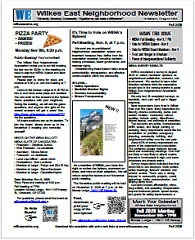
It’s Time to Vote on WENA’s Bylaws! Fall Meeting, Nov 9, 2026 7PM

It’s Time to Vote on WENA’s Bylaws! Fall Meeting, Nov 9, 2026 7PM. We want you to participate! Info here!

We want you to participate!

Neighborhood association bylaws are important because they define how the association operates, including decision-making processes, board governance, and member rights.

Understanding these bylaws helps ensure accountability, transparency, and effective communication within the community.

BYLAWS…

  • Define Operations
  • Establish Member Rights
  • Promote Accountability
  • Ensure Transparency

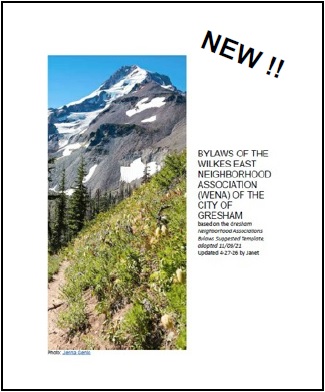
As a member of WENA, you have the right to review the bylaws, comment on them, and vote on their adoption.. We will vote to adopt the bylaws at our November public meeting.

The November public meeting will be held on November 9, 2026 at 7 p.m. at the Moose Lodge, 16411 NE Halsey St.

Download your copy of the Wilkes East NA 2026 Bylaws here!

Play our 2026 Bylaws Game! Info here https://www.wilkeseastna.org/node/3787

Food And Hunger In Gresham

By Janet Unruh, WENA Board Member

About five decades ago, I was recently divorced and living on my own. Although I had a college degree, I turned to “temp” work, and I was sent on interesting and challenging assignments in a variety of offices and factories. I lived on the minimum wage, which was just over three dollars per hour then. I had a studio apartment in a hip part of town—the rent was $195 per month—and a car. I never worried about money. I was able to pay the rent and all the bills. Gas for the car was $1.25 per gallon. I’d go to the ATM and get a ten-dollar bill for going out with friends. I didn’t have credit cards. That’s how affordable life was.

Today, something as basic as food is becoming unaffordable for many households. The overall inflation rate doesn’t reflect what consumers pay at the grocery store, and shoppers are changing their habits in response[1]. According to the Bureau of Labor Statistics, grocery prices in the West increased 28.7% between August 2020 and August 2026[2]. In Oregon, the cost of basic necessities has risen faster than overall national inflation, according to United For ALICE[3] (described next).

ALICE VERSUS THE FEDERAL POVERTY LEVEL
According to the World Population Review website, Gresham has a poverty rate of 13.04% as of 2026[4]. This is calculated using the Federal Poverty Level (FPL), which is used to determine eligibility for various subsidies. ALICE, which stands for Asset-Limited, Income-Constrained, Employed, is a research initiative of United For ALICE. ALICE households have incomes above the FPL, but still cannot afford basic necessities.

The ALICE Threshold includes both households living in poverty and those earning above the poverty level but unable to afford basic necessities. Using 2024 ALICE data for six ZIP codes covering Gresham and nearby communities—97230, 97233, 97236, 97024, 97030, and 97080—the combined percentage of households that fall below the ALICE Threshold is 54%[5, 6]. That’s considerably worse than Gresham’s 13.04% FPL.

WHAT IS SNAP?
SNAP (Supplemental Nutrition Assistance Program) provides monthly grocery benefits to eligible low-income households through an EBT (Electronic Benefits Transfer) card. Nearly 15% of Oregonians receive SNAP benefits. SNAP does not cover total food costs for its recipients[7]. More than 54% of SNAP participants are in families with children; more than 37% are in families that include older adults or people with disabilities; and more than 41% are in working families[8] (categories overlap). Not only does SNAP benefit recipients, it also supports Oregon’s economy. Each month, more than $123 million in SNAP benefits are spent at grocery stores, farmers markets, and other food retailers in Oregon[9].

On July 4, 2025, President Donald Trump signed the One Big Beautiful Bill Act into law—enacting major cuts to federal food and health assistance programs. The law phases in its provisions on a staggered schedule over the next decade, reducing SNAP food assistance and other subsidies[10]. As of June 2026, 126,000 fewer Oregonians were receiving federal food assistance compared to the same time last year[11].

THE 80-HOUR WORK RULE
One of the biggest changes to SNAP is the expansion of work requirements, which apply to an increasing number of Oregonians. Adults ages 18–64 without children under 14 in their household may now be subject to SNAP work requirements unless exempt. They are categorized as able-bodied adults without dependents (ABAWDs). They generally must complete 80 hours of work or approved activities, such as qualifying training or volunteer work, each month. Those who don’t meet the requirement can receive only three “countable” months of SNAP during Oregon's current three-year period, January 2025 through December 2027. The countable months don’t need to be consecutive. After three countable months, benefits generally end unless the person meets the work requirement or qualifies for an exemption[12].

Exemptions may apply to people with qualifying health conditions, caregivers, certain students, and others. Veterans, people experiencing homelessness, and former foster youth no longer automatically exempt[13, 14]. The Oregon Department of Human Services (ODHS) is encouraging people to contact the agency so staff can review their situation.

Presumably, the intent of requiring work is to reduce dependence on subsidies. However, ABAWDs don’t necessarily get a job if their SNAP benefits are cut. Research from the Urban Institute and the Hamilton Project shows that SNAP work requirements don’t boost employment but instead cause participants to drop out of the program[15, 16].

WHAT IS OREGON DOING TO HELP?
In 2026, Oregon lawmakers approved funding, computer system upgrades, and additional staff to administer SNAP and handle increased caseloads. They also approved limited, temporary assistance for immigrants who lost federal benefits. The legislators did not, however, pass bills to support the School Meals For All Initiative, or fund investments in Oregon’s Food Assistance Network[17, 18].

CAN FOOD BANKS MAKE UP THE DIFFERENCE?
Unfortunately, it looks unlikely, although they are making a heroic effort. Oregon Food Bank estimates that SNAP provides nine meals for every one meal supplied by food banks. According to Oregon Food Bank’s 2026 State of Hunger Report, food bank visits across Oregon and Southwest Washington increased 51% over the past two years, reaching 2.9 million visits last year[19].

WHAT WE CAN DO NOW
If you’re not already doing something to help, start now. There are plenty of ways to donate time, effort, food, and money. I set up a monthly donation to Thimbleberry Collaborative Farm(https://thimbleberrycollaborativefarm.org/) in Boring. It is a 501(c)(3) nonprofit that runs a five-acre organic farm. This year, they donated 12,000 pounds of produce to food pantries in East Multnomah and Clackamas Counties, operated a free food stand, and provided meals[20]. See my article in this newsletter, Thimbleberry Collaborative Farm.

SnowCap Community Charities (https://www.snowcap.org/) is a 501(c)(3) nonprofit that provides food, clothing and other basics. They distribute prepacked food plus fresh and frozen food. SnowCap brings food to low-income schools and apartment complexes to reach children whose families are unable to get to their pantry. They also deliver food boxes and fresh produce to homebound seniors once a month[21].

East County Food Pantry (https://eastcountyfoodpantry.org/) provides food to people on Saturday mornings. They serve 3,000 people per month with a variety of produce, bakery goods, and other assorted grocery items. Food is supplied by Oregon Food Bank, Urban Gleaners, Clackamas Service Center, and others. The pantry is at Smith Memorial Presbyterian Church in Fairview. You can donate and sign up to volunteer on their website. They offer short shifts of one to four hours per week[22].

CONCLUSION
Now that we know more about the immediacy of food and hunger, we need to mobilize because the problem of hunger in Wilkes East and Gresham is on a worsening trajectory, with no resolution in sight. Ultimately, when the community pulls together, we gain friends and purpose, and all of us benefit. Let’s work to restore goodwill toward others and build a sense of community solidarity.

(Endnotes below this break)

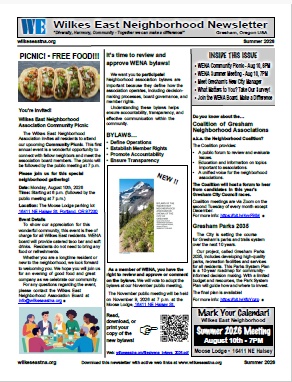
Download the Wilkes East Neighborhood Summer 2026 Newsletter here!

Download the Wilkes East Neighborhood Summer 2026 Newsletter here! Wilkes East Neighborhood, Gresham Oregon USA. Diversity, Harmony, Community- Together 'WE' can make a difference.

Summer 2026 Newsletter

"Diversity, Harmony, Community -
Together 'WE' Can Make a Difference!”


alt=Read it now!

Summer 2026 Newsletter

Inside This Issue:

  • WENA Community Picnic - Aug 10 6PM
  • WENA Summer Meeting - Aug 10 7PM
  • Meet Gresham's New City Manager
  • What Matter to You? Take Our Survey!
  • Join the WENA Board. Make a Differencce

Download your copy here. (includes active web links)

¡Descargue nuestro boletín en español aquí!. (incluye enlaces web activos)

Newsletters are a regular publication of the Wilkes East Neighborhood Association. They are hand-delivered to over 1,500 residences and businesses in our area 3 times per year, timed to correspond with our general meetings.

View archive   |   Policy & Ad Rates

Got a story or tip to share?
Wilkes East residents are encouraged to submit articles and tips for the newsletter. Articles should be limited to 300-400 words and may be subject to editing. Include a related photo. Send by email to chair@wilkeseastna.org.

Volunteers Needed
Newsletters are hand-delivered to Wilkes East residents and businesses by neighborhood volunteers. There are always routes that need delivery people. Routes are small and many. We can always use your help.
To volunteer contact chair@wilkeseastna.org.

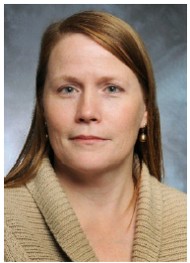
Who is Teresa Carr, Gresham’s new city manager?

Who is Teresa Carr, Gresham’s new city manager? Find out here!

By Janet Unruh, WENA Board Member

Most of the coverage of Teresa Carr's appointment as Gresham's city manager has focused on the announcement.

A closer look at her background reveals an accomplished executive with extensive management experience and a high level of professionalism—and one aspect that I found unexpected and especially interesting.

Carr was chosen after a nationwide search and became Gresham’s city manager in June. As you may know, the city manager oversees the day-to-day operations of Gresham and plays a major role in implementing City Council policies, preparing the budget, and directing city departments.
Before coming to Gresham, Carr spent more than 26 years with the Port of Portland, where she held increasingly responsible leadership positions. Her positions included development project manager, business development manager, director of commercial properties, and director of business development and properties. Ultimately, she led a team managing five business parks, three marine terminals, and over 300 active leases, supporting over 300 companies, 32,000 jobs, and generating $177M in state and local tax revenue[1].

One indication of Carr's professional standing is her membership on an Urban Land Institute (ULI) Product Council. ULI is the world's oldest and largest global network of cross-disciplinary real estate and land use experts. ULI Product Councils are exclusive, peer-to-peer forums designed for senior industry leaders to share confidential information, debate trends, and exchange best practices in specific sectors of real estate development and land use. These councils operate on a "closed-door" basis, fostering a candid environment where competitors and colleagues can discuss the "state of the art" in their respective fields without public scrutiny. Membership is highly selective, typically capped at 50 members per council, and is available only to ULI Full Members by application or invitation[2].

Carr also serves on the board of the National Association of Industrial and Office Properties (NAIOP) and is a member of the Commercial Real Estate Women (CREW) Future Leaders Committee.

Here's what I found interesting and unexpected: aside her commercial real estate experience, Carr has also become involved in affordable housing policy. “The Homelessness and Housing Committee on January 13 voted to send the Gresham-nominated appointment of Teresa Carr to the Home Forward Board of Commissioners to the full Portland City Council for confirmation[3].” Home Forward, formerly the Housing Authority, manages low-income housing in Multnomah County. (Cathy Keathley, City of Gresham city councilor, is also on the Home Forward Board of Commissioners.)

Carr submitted the following acceptance statement highlighting her interest in housing issues:
Housing affordability and access are among the most urgent challenges facing communities across the region, including the City of Gresham and Multnomah County. I am honored to serve on the Home Forward Board on behalf of the City of Gresham, bringing both a regional perspective and a deep appreciation for the role stable housing plays in creating opportunity, dignity, and long-term well-being. Having grown up with very limited resources and experienced supported housing firsthand, this work is both personal and meaningful to me.

I am grateful for the opportunity to support Home Forward’s mission and strategic goals, including expanding access to housing, strengthening resident stability, and stewarding public resources responsibly. I believe that everyone, regardless of background, deserves a safe and stable place to call home, and I am committed to contributing my experience and perspective in service of outcomes that strengthen individuals, families, and the broader community[4].

Her education includes a bachelor’s degree in public relations, advertising, and applied communication. She also earned a master’s degree in public administration (MPA), with a focus on organizational leadership, and personnel management.

As Gresham's city manager, Carr will play a key role in shaping the city's approach to real estate development and affordable housing. Her background suggests she recognizes that these issues are interconnected and require a comprehensive approach. Cuts to budgets and programs at the federal, state, and county levels threaten Gresham's ability to serve low-income constituents. I hope Carr's combination of executive experience and personal understanding of housing challenges will serve Gresham well in the years ahead.

(Footnotes below this break)

Sara and the Thousand Acres Homeless Camp

Tagged:  

By Janet Unruh, WENA Board Member

Note: The name of Sara's former employer has been changed.

The humane approach
When Sara led a site remediation team to evict homeless camp residents and remove the debris, she believed she was doing necessary work. Less than a year later, she had quit that job, and was instead helping the people she had once evicted.

The encampment was in the Thousand Acres Park, a forested area northeast of Troutdale on the Sandy River Delta, not far from the Wilkes East neighborhood. The park includes 50 acres of land owned by the Oregon Department of State Lands (DSL), next to 1,500 acres owned by the U.S. Forest Service.

The residents had been living in camps on the DSL land—some of them, for as long as 25 years. In 2025, DSL decided to evict them. It was necessary because, according to DSL, the land is not suitable for habitation because of wildfire risk, flooding, and environmental degradation. So, in June 2025, DSL sent hazmat contractors to force the residents out and clean up the area.

This brute-force approach failed because the camp residents and their sympathizers erected barriers and trenches, and fought the contractors. Several activists were pepper-sprayed, including one who was there to video the proceedings. The governor suspended the cleanup efforts while the incident was being investigated.

DSL then decided to take a more humane approach. They hired Egret Site Remediation, Inc. (ESR) because it was a company that would work with the residents to gain their trust and persuade them to pack up and leave.

Sara (last name withheld) worked for ESR. She told me she believed camps should be removed because of biohazards, human waste, unsafe living conditions, and environmental damage. But she also believes removals should be carried out with dignity, transparency, and respect for the people affected.

Sara had worked on several large cleanups before she led the cleanup crew at Thousand Acres. However, Thousand Acres turned out to be different from other cleanups because people had lived there in the woods for many years and they had an established community that they regarded as family. Thus, the humanity of the situation was much more emotional than the other cleanups.

What can I do to help?
I met Sara on NextDoor after the camps at Thousand Acres had been removed. At that point, she had resigned from ESR because of a change in the company culture. When she began working for ESR, part of the company’s mission was to bring an empathetic approach to the work, and to do so they hired people who have lived experience. But over time, management became less humane and more profit-oriented.

Sara herself had had a tough life, and she had a gift for defusing tense situations. This was to serve her well.

Sara had connections in the activist community, and before she began the work on Thousand Acres, she contacted someone she knew, and he got a few of the residents to agree to meet with her. Then, when she went in to the camps, she attended a “council meeting” of the residents. These meetings were held every two weeks to coordinate efforts, discuss problems, and help each other.

At the meeting, Sara told them, “Listen, somebody's going to clean this place up. And I'm telling you guys, I have a couple of weeks to convince you guys that you want it to be me and the company that I represent, because other people would be coming in here and spraying you with mace.” She told them other people wouldn’t care about their things. Other people wouldn’t hold value to their property. Other people, like the contractors that came last time, would come in with a chip on their shoulder. They would be nervous and scared because of what they heard about how the residents fought back in June. They would come in ready to tear down homes. Only they would not view them as homes. She told them, “We’re not like that. We’re respectful.” Then she said, “What can I do to help?”

As one resident told KATU, "I mean, she's a good person. She has a shitty job to do. Nowhere are you ever gonna go throw people out of their homes and be received well. She's done a hell of a job of getting our respect and understanding, and she has got a thing to do, so she's going to do it.”

Winning trust
Sara organized weekly meetings with people at the camps, and they cooperated with her. They showed her some camps that had been abandoned and the ESR team cleaned those up first. Then, she began working with the residents, helping them sort their things, get packed up, and throw away trash.

Sara got to know the residents. Her background was like theirs and they respected that. The experience of working with the residents of Thousand Acres affected her much more deeply than anything she had done for ESR until then. As time went on, she began to feel like a mercenary who betrayed her people. She felt empathy for them; so much so that she called them “her tribe.”

During this time, Sara began to have conflicts with others on the ESR management team. She felt that the company culture had become harsher in its approach to cleaning up camps. It was not the same company that she had respected in the past. After several escalating disagreements, she accepted a mutual separation with severance—which she hasn’t received.

Sara’s husband had been terminated from ESR because of conflicts with management earlier in the year.

Eviction day
From August until late in September, while Sara worked with the residents to help them pack up, social workers tried to find housing for them. Residents knew they had to leave, and the cleanup efforts moved along, but no deadline had been given.

Suddenly, on September 26, DSL announced that the residents had to vacate immediately. Legal notices were posted informing residents that the area would be closed on October 1st—five days later. By that time, some residents had been placed in housing—about 14 people—but 35 others had turned down temporary housing that offered bunk beds and no privacy. They had nowhere to go.

The task of packing up and moving on short notice was overwhelming, and there was a sense of panic. Sara and her husband both have trucks, and they had already been helping residents move their belongings to storage, but they sped up their efforts, even making trips from the camps to storage at night. Still, they couldn’t help everyone, and many ran out of time.

On October 1, 2025, DSL, the Multnomah County Sheriff's Office, and more than 100 law enforcement officers, carried out the closure of the Thousand Acres encampment. They allowed Sara to go in and give everyone a one-hour warning. It was a cold, rainy day. The remaining 35 residents gathered up what they could and left the place that had been their home.

When the officers swept the camp sites, residents’ possessions were transported to a warehouse. Residents were told to get their belongings in a month. But the rules required an address for the delivery of belongings. Sara offered her address for deliveries, but that wasn’t acceptable. Because of this, most of the former residents lost their belongings. When this happens to homeless people, they often lose their medications, IDs, papers needed for social services, contact information for friends and family, letters, photos, and keepsakes. There was no follow up from the Homeless Services Department. All outreach ended.

I won’t let them fail
“We’ve just been running from one place to the next. ‘You can’t be here, you can’t be here, you can’t be here,’ [they say]. Well, where can we be? That’s the question no one seems to be able to answer,” said one of the former residents. There were no good options, only the streets.

And then, quietly, many returned to Thousand Acres. Only this time, they encamped on Forest Service land, which is outside DSL’s jurisdiction, and therefore they aren’t threatened by another DSL eviction. Sara knows where they are and continues to visit them—not to prepare them for eviction, but to collaborate on plans for the future.

Why did the former residents return? Sara put it this way: that pain brought them together, and no matter what their stories may have been, they were welcomed into the family. Once again, they live together and help each other—and this is more important than shelter and a normal life. For them, Thousand Acres is a place to heal.

And what about Sara? Over the course of less than a year, Sara quit a job that she had believed was beneficial to society, and became an advocate for the Thousand Acres residents. Today, Sara and her husband operate their own cleanup company, but they no longer remove homeless encampments.

Sara told me she has no regrets and believes that everything happened for a reason. She believes the Thousand Acres residents could live on land somewhere legally and govern themselves. Right now, she doesn’t see how they can get there, but she believes it’s possible and she has confidence in them.

“I won’t let them fail,” she told me.

(References below this break

Syndicate content